

Rethinking Security Monitoring for Houston Workplaces
Security monitoring is no longer just about a burglar alarm beeping in the middle of the night. For Houston businesses, it now means keeping eyes on alarms, cameras, access control, fire, and building systems all day and all night, then getting help moving fast when something is wrong. With crime concerns in business areas and more intense storms during Gulf hurricane season, this is not a “nice to have” any more.
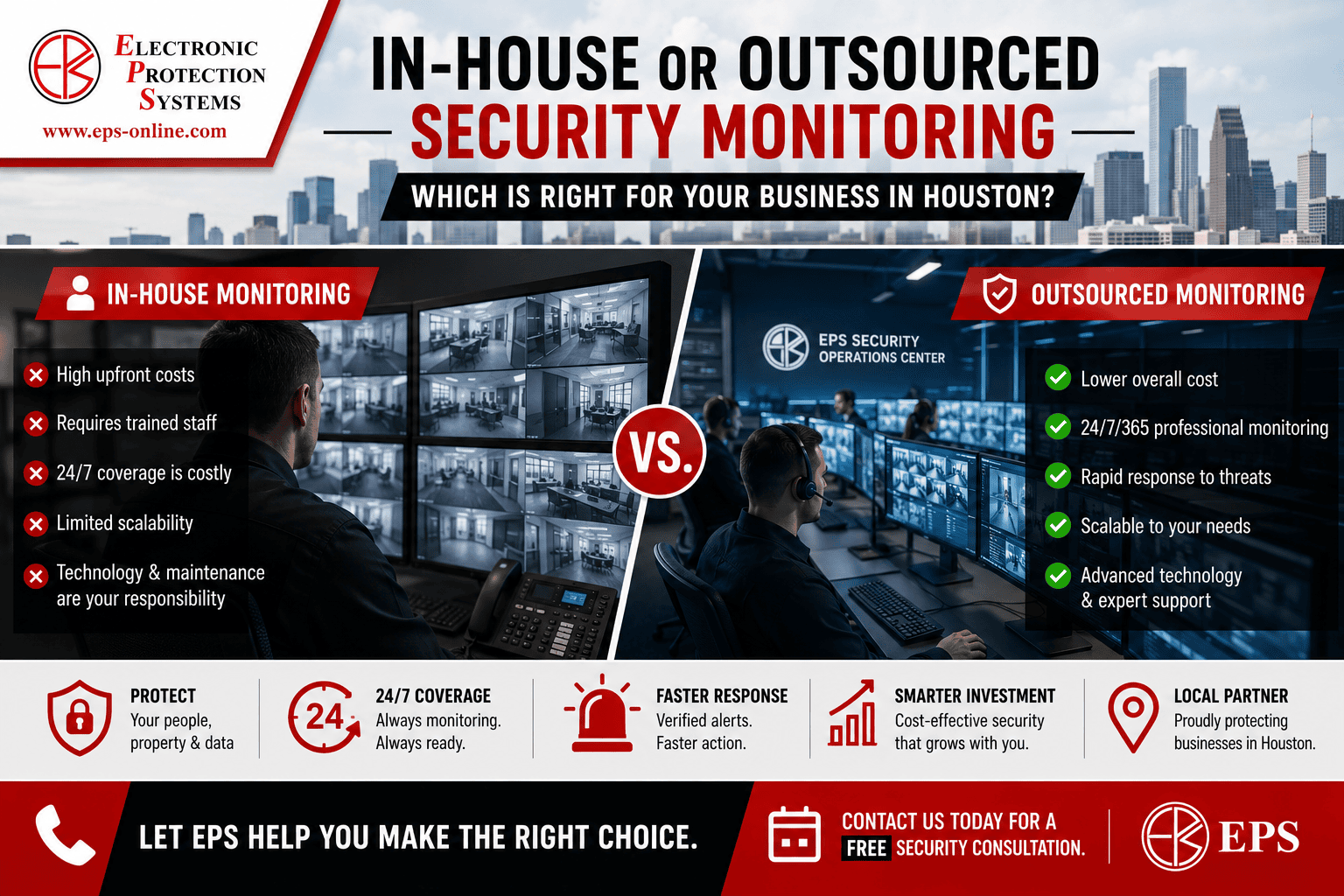
The big question is how to handle that monitoring. Do you build your own in-house team and try to cover everything yourself, or do you work with professional security monitoring services in Houston to watch over your systems? That choice affects your budget, hiring plans, legal risk, and how ready you are when an emergency hits. We will walk through how costs really stack up, what it takes to staff a 24/7 operation, how liability works, and where a hybrid approach can be the best middle ground.
True Cost of In-House Monitoring vs. Outsourced Services
When business leaders first think about in-house monitoring, they often picture a couple of screens in a back office. In reality, doing it yourself means building a small control center.
Some of the main upfront needs include:
- A secure monitoring room with controlled access
- Reliable servers, storage, and hardened network equipment
- Multiple consoles for alarms, video, and access control
- Backup power, backup internet, and failover plans if systems go down
Those are just the physical pieces. To keep that room running, you then have ongoing staffing costs. A single 24/7 seat requires multiple people to cover all shifts, plus supervisors and IT support. Every person comes with payroll taxes, benefits, and training time. There are also software licenses, system updates, and repair bills when something breaks at the worst time.
With outsourced monitoring, the bill looks different. You usually pay a recurring fee that can scale based on:
- Number of locations
- Types of services monitored, like intrusion, fire, video, or access control
- Any special handling, such as video verification or custom procedures
The big advantage is that the central station spreads its heavy infrastructure across many businesses. You do not have to build a hardened monitoring center, keep generators ready, or buy extra servers just in case. Instead, you have more predictable monthly costs, and you are not stuck with surprise capital expenses when your own monitoring hardware fails.
For Houston businesses, there are a few local twists. Certain commercial areas and industrial corridors may want a higher level of monitoring readiness because of higher risk. That raises the bar for in-house systems even more. Hurricane season adds another layer. Staying online during storms may require offsite backup locations and serious redundancy, which can be hard and expensive to maintain yourself. Professional monitoring centers are built with this kind of resilience in mind.
Staffing, Training, and 24/7 Coverage Realities
The math of staffing your own monitoring team is often the part that catches leaders off guard. A single chair filled 24 hours a day, 7 days a week, usually means 4 to 5 trained employees once you factor in days off, sick time, breaks, and vacation. That is before you add supervisors or technical support.
Hiring those people in a busy city like Houston is not always easy. Night and weekend shifts are harder to fill. Some locations want bilingual operators who can work calmly with callers in stressful moments. Turnover in high-alert roles can be higher, which means more recruiting and retraining. Every time someone leaves, your risk of human error goes up while a new person learns the systems.
Training is not just about learning where the buttons are. Monitoring staff should know:
- Alarm verification steps so they do not ignore real threats or call for help too late
- How to read video feeds and spot true risks
- Basic fire alarm and life safety response, including who to call and when
- Local procedures for emergency dispatch and escalation
There are standards and codes that guide many of these processes. When internal teams do not follow them, it can lead to fines or leave you exposed if something goes wrong. Professional centers build training programs around these requirements and track performance across many events, day after day.
Operational resilience is another concern. During heavy storms, major games, or large city events, call volume can spike and alarms can stack up. A small in-house team might struggle to keep up. A regional monitoring center can plan for surge events, bring in extra staff, and fail over between sites if one area is impacted. Many businesses find a hybrid setup works well, with on-site security or facilities staff by day, and professional monitoring support at night, on weekends, and during holidays.
Liability, Compliance, and Insurance Impacts
When an alarm is missed or handled poorly, the question quickly becomes, who is responsible? With in-house monitoring, much of that risk sits on the business. If your own team fails to follow a clear plan, that can come up in legal reviews and insurance discussions.
With outsourced monitoring, expectations are typically set in formal agreements. Those documents spell out:
- What the monitoring center will do when it receives different alarm types
- How operators document events and escalations
- Any limits, exceptions, or shared responsibilities
Courts and insurers often look at whether your monitoring and response were reasonable and lined up with common industry practice. If your internal processes are casual, undocumented, or not tested, that can cause problems.
Fire and life safety systems add even more weight. Fire codes, UL standards, and NFPA guidelines may call for specific monitoring practices, regular tests, and recordkeeping. Some industries like healthcare, financial services, and certain industrial sites have extra layers of compliance. Running all of that in-house takes strong coordination between security, safety, and IT teams. Many companies prefer to work with an integrated provider that keeps fire, intrusion, access control, and life safety monitoring aligned with current codes.
Insurance is tied closely to all of this. Professional, well-documented monitoring can support better terms in some cases, or at least show that your business takes risk seriously. On the other side, if an incident occurs and your in-house team is found to be undertrained or understaffed, it can make claims more difficult. Detailed logs and video verification from a monitoring center often help support investigations and claim reviews.
Matching Monitoring Models to Your Houston Business
There is no one answer that fits every organization. Some business types are better positioned to handle in-house monitoring, such as:
- Larger campuses that already have a strong security department and IT staff
- Critical operations that require people with deep knowledge of internal processes
- Organizations willing to invest in purpose-built facilities and ongoing training programs
For many small and mid-sized businesses, outsourcing security monitoring services in Houston is a better fit. It offers:
- Faster setup and fewer internal projects to manage
- Professional operators watching alarms 24/7 under clear procedures
- Access to advanced tools like integrated cameras, access control, and automation without building that stack yourself
The middle ground is a hybrid model. In these setups, internal staff handle what they know best during business hours, like visitor management or process checks, while professional monitoring covers nights, weekends, and storm periods. On-site guards and remote monitoring can work together so someone is always ready to respond. Integrated providers like Electronic Protection Systems design systems with this flexibility in mind, bringing together cameras, access control, intrusion, fire, and automation so your monitoring strategy can grow and change over time.
Protect Your Houston Property With Proactive Security Monitoring
If you are ready to strengthen your security and gain peace of mind, our team at Electronic Protection Systems is here to help. We tailor our security monitoring services in Houston to match the unique risks and layout of your property, so you are never relying on a one-size-fits-all solution. Reach out today to discuss your goals, and we will design a monitoring plan that keeps your people, assets, and operations safer around the clock.