

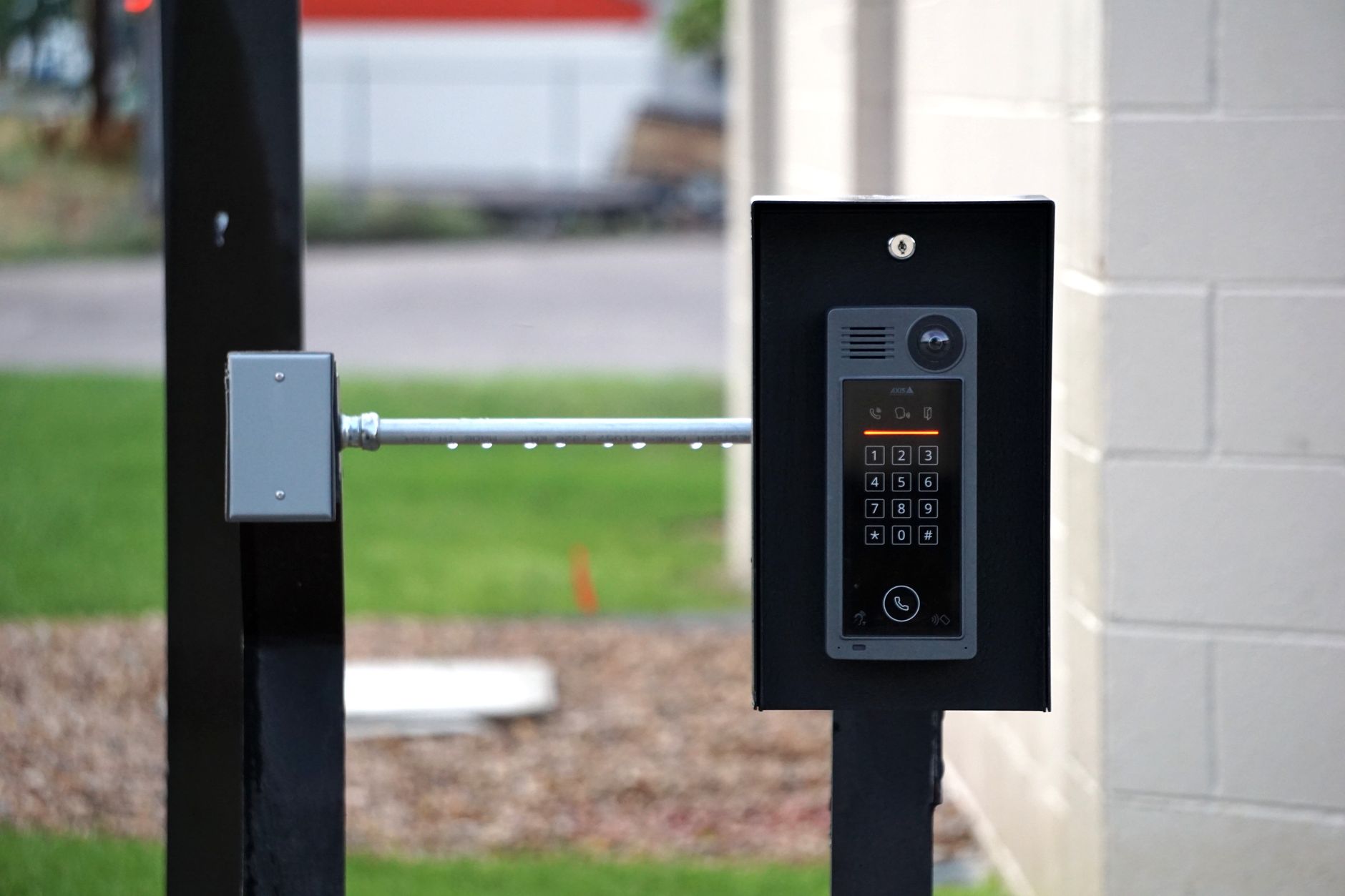
Apartment access control replaces keys with electronic credentials—key fobs, mobile apps, or PIN codes—that control who enters building doors, parking garages, pools, gyms, and mailrooms. A basic multifamily system runs $1,500 to $3,000 per controlled door installed, plus $10 to $50 per door monthly for cloud management. For a 100-unit complex, expect an initial investment of $15,000 to $40,000 depending on the number of entry points and whether you reuse existing wiring. This guide explains how apartment access control works, what it costs, and how to choose an installer that will still answer the phone after the wiring is buried.
What Is Apartment Access Control?
Apartment access control is an electronic system that manages entry to shared spaces in a multifamily property without physical keys. Instead of a metal key that can be copied at any hardware store, each resident receives a credential—a fob, a mobile phone app, or a code—that grants access only to the doors they are permitted to use.
The system logs every entry, so property managers can see who came through the garage at 2 a.m. or which vendor entered the mechanical room. When a resident moves out, their credential is deactivated in seconds rather than requiring a lock rekey.
A typical apartment access control setup covers:
- Main building and lobby entrances
- Parking garage gates and pedestrian doors
- Amenity spaces (pool, fitness center, clubhouse, business center)
- Mail and package rooms
- Elevator floor restriction
- Maintenance and mechanical areas
The National Institute of Standards and Technology defines access control as the selective restriction of access to a resource, and that is exactly the value for landlords: the right people reach the right doors, and everyone else is kept out and recorded.
How Does Apartment Access Control Work?
Apartment access control works by pairing a credential with a reader mounted at each door, connected to a controller that decides whether to unlock. When a resident taps a fob or opens a mobile app, the reader sends the credential to the controller, which checks it against a permissions database and releases the electric strike or maglock if the person is authorized.
Modern systems are cloud-managed, meaning the permissions database lives on a server that property managers reach through a web browser. That removes the need for on-site software and lets a manager add or revoke a resident from anywhere.
The core components
- Credentials — fobs, cards, smartphone apps (Bluetooth or NFC), or PIN keypads.
- Readers — mounted at each door; read the credential.
- Controllers — the brain that grants or denies access and stores logs.
- Locking hardware — electric strikes for wood doors, magnetic locks for glass, gate operators for garages.
- Software — the management portal for adding users, setting schedules, and pulling reports.
Mobile credentials are growing fastest because residents rarely lose their phones and never share a code the way they share a gate clicker. Systems built on the Alarm.com platform, for example, tie access events to video so managers can see the person who used a credential, not just the log entry.
How Much Does Apartment Access Control Cost?
Apartment access control costs $1,500 to $3,000 per door for installation, plus a recurring $10 to $50 per door per month for cloud software and support. The single biggest variable is the number of doors, not the number of units.
Sample budget ranges
- Small property (2–4 controlled doors): $4,000–$12,000 up front, $30–$150/month
- Mid-size complex (8–15 doors + garage gate): $18,000–$45,000 up front, $150–$600/month
- Large community (20+ doors, amenities, elevators): $50,000+ up front, $600+/month
Costs climb when you add gate operators ($3,000–$8,000 installed each), elevator floor control, or video-integrated readers. Costs drop when existing structured cabling can be reused and when you standardize on mobile credentials to eliminate ongoing fob purchases (fobs run $5–$15 each and add up across turnover).
Ask any installer whether the monthly fee is month-to-month or a locked multi-year contract. Long contracts are common in this industry, and they matter: a five-year term on a large system can quietly commit a property to $30,000 in software fees.
Why Do Competitors Rank First for Apartment Access Control?
Large national brands like ADT and camera manufacturers like Avigilon rank first for apartment access control because they publish deep service pages and buy national ad coverage—not because they install faster or price better for a Louisiana or Texas property. Their pages answer the search well but rarely address local permitting, local response times, or who shows up when a garage gate fails at midnight.
Where a national installer sends a subcontractor and a ticket number, a local specialist can walk the property before quoting and return the next day for service. That difference does not show up in a search ranking, but it shows up in a property manager’s Monday morning.
What to look for that the big pages skip
- Local service radius. A crew based near the property means same-week installs and faster repairs.
- No forced long-term contract. Month-to-month software keeps leverage with the property owner.
- Takeover capability. A good installer can adopt existing readers and wiring instead of forcing a full replacement.
- Named point of contact. Not a national call center queue.
The honest trade-off: a national brand may offer broader nationwide portfolios if you own properties in many states. For a single Louisiana or Houston-area complex, a local installer usually wins on cost, speed, and accountability.
What Access Control Systems Work Best for Multifamily Buildings?
The best apartment access control systems for multifamily buildings combine mobile credentials, cloud management, and video integration on an open, non-proprietary platform. Proprietary systems that lock you into a single vendor’s fobs and service plan cost more over the life of the property.
Recommended features by priority
1. Cloud management so a manager updates permissions remotely.
2. Mobile credentials to cut fob costs and eliminate shared codes.
3. Video-verified access to tie every door event to footage.
4. Scheduling for amenity hours (pool closes at 10 p.m., gym opens at 5 a.m.).
5. Audit logs for disputes, incidents, and insurance claims.
Glass lobby doors typically need magnetic locks with request-to-exit sensors and code-compliant emergency release. Garage entries need gate operators paired with vehicle readers or app-based entry. Elevators in mid-rise buildings often need floor-by-floor restriction so residents only reach their own floor.
Match the hardware to the door, not the other way around. A reputable installer surveys each opening and specifies strikes, maglocks, or gate operators individually rather than selling one kit for the whole property.
How Long Does Installation Take?
Installation of apartment access control typically takes one to four weeks for a mid-size complex, depending on door count, wiring conditions, and gate work. A single-building property with existing conduit can be live in a few days; a sprawling garden-style community with buried cable runs takes longer.
Typical project timeline
- Week 1: Site survey, door-by-door assessment, and system design.
- Week 2: Hardware procurement and any electrical or low-voltage cabling.
- Week 3: Mounting readers, controllers, and locking hardware; programming.
- Week 4: Resident credential enrollment, staff training, and go-live.
The slowest step is usually cabling, not the electronics. Properties built with structured wiring already in place skip most of that. Weatherproof gate installs can add time because trenching and concrete work depend on ground and permits.
For a resident-facing rollout, plan a transition week where old keys or clickers still work alongside new credentials, so nobody gets locked out during enrollment.
How Do You Manage Residents and Turnover?
You manage residents and turnover through the cloud portal, where each move-in adds a credential in seconds and each move-out deactivates one instantly—no lock rekey required. This is the single biggest operational win over physical keys for a property with regular turnover.
Practical management workflow
- Move-in: Issue a mobile credential or fob and assign permissions (their door, garage, amenities).
- Move-out: Deactivate the credential the day the lease ends; any lost fob becomes worthless.
- Vendors: Grant time-limited access to a plumber or cleaner for a specific window.
- Incidents: Pull the log for any door to see exactly who entered and when.
Compare that to a rekey: after a single lost master key, a keyed building may need every affected lock changed, at $75–$200 per cylinder. Access control makes that risk disappear. For properties that also want cameras and monitoring, integrating access with a professionally monitored system means an unauthorized forced entry can trigger a real response, not just a log entry. Providers such as Electronic Protection Systems install and monitor access control for apartment complexes across Louisiana and the Houston area, and you can review the full range on our security services overview.
What Questions Should You Ask an Installer?
Ask an installer about contract length, service response time, credential costs, and whether the system is proprietary before you sign anything. The answers separate a partner from a vendor.
A checklist before you commit
- Is the monthly software fee month-to-month or a multi-year contract?
- How fast do you respond when a door or gate fails?
- Are you local, or do you dispatch subcontractors?
- Can you take over and reuse our existing readers and wiring?
- What does each additional fob or mobile credential cost?
- Is the platform open, or am I locked into your hardware forever?
- Do you integrate access control with cameras and 24/7 monitoring?
- What is your labor warranty, and what is covered?
Get the full scope in writing, including the number of doors, hardware model numbers, and the monthly total. A vague quote hides expensive surprises. A specialist who surveys every opening, quotes each door, and offers flexible terms will nearly always deliver a lower total cost of ownership than a national brand selling a one-size box—and will be the one who actually shows up when a gate jams.